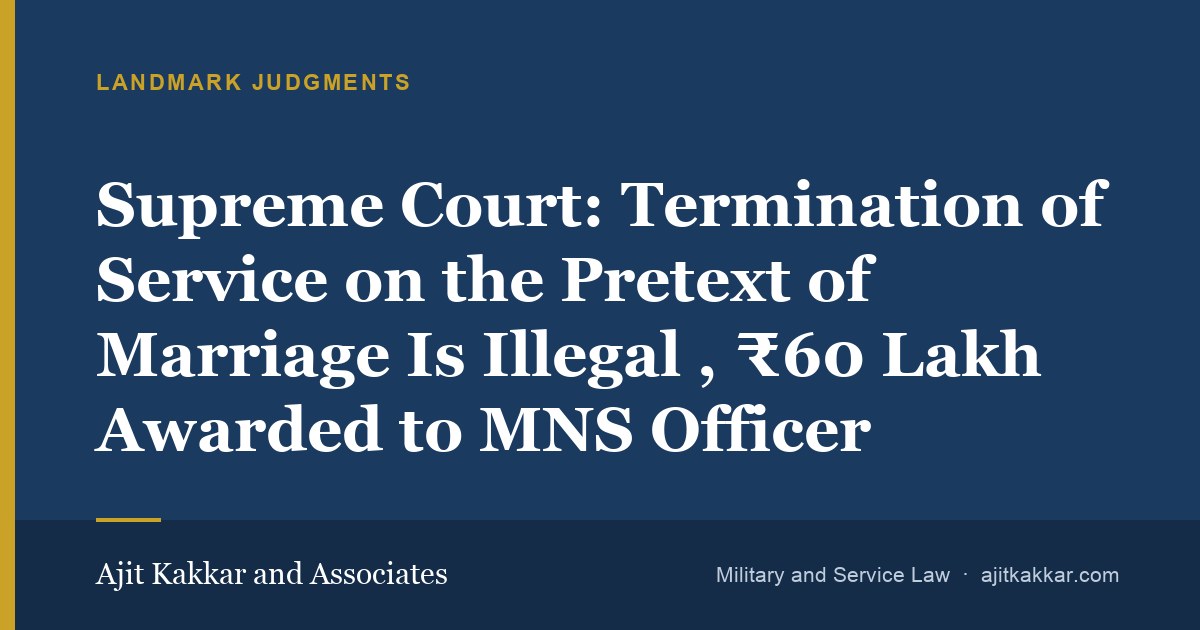
Union of India & Ors. v. Ex. Lt. Selina John, Civil Appeal No. 1990 of 2019, Supreme Court of India, decided 14 February 2024.
Background
Ex. Lt. Selina John was a Permanent Commissioned Officer in the Military Nursing Service (MNS). Her services were terminated for one reason only: she had got married. The action rested on Army Instruction No. 61 of 1977 (“Terms and conditions of service for the grant of permanent commissions in the Military Nursing Service”), which then governed women nursing officers. She challenged her release before the Armed Forces Tribunal, Regional Bench, Lucknow, which held the discharge illegal and directed reinstatement with back wages. The Union of India appealed to the Supreme Court, defending the termination as being in accordance with the rules of the time.
What the Supreme Court Held
The Court held the termination wrong and illegal. Ending a woman’s employment because she has married is a coarse and manifest form of gender discrimination: it undermines human dignity, violates the right to non-discrimination and denies the fair and equal treatment the Constitution guarantees. A rule does not become sustainable merely because it historically applied to women nursing officers.
The Court rejected the patriarchal assumption that marriage renders a woman unfit or unavailable for public service — thinking that forces women to choose between professional and marital life, contrary to constitutional morality. In doing so it followed the line of C.B. Muthamma v. Union of India (1979) and Anuj Garg v. Hotel Association of India (2008). Significantly, Army Instruction No. 61 of 1977 had itself been withdrawn on 29 August 1995, so the very foundation for such action no longer existed.
Compensation of ₹60 Lakh in Lieu of Reinstatement
While affirming that the termination was illegal, the Supreme Court modified the AFT’s relief. Given the passage of time — and noting that the officer had briefly worked in a private organisation after her release — the Court awarded a lump sum of ₹60,00,000 (sixty lakh rupees) instead of reinstatement and back wages, payable within eight weeks, with 12% annual interest on default, in full and final settlement of all claims.
What This Means for Service Personnel
Three practical takeaways: (1) a termination that rests on a discriminatory ground — marriage, gender or a stereotype about either — is open to challenge, and courts will not let an outdated instruction shield it; (2) relief is moulded to the facts, so decades of delay may convert reinstatement into compensation — acting early protects the fuller remedy; and (3) the ruling strengthens every pending claim by women officers against marriage- or gender-based service conditions. If your release or discharge was founded on a rule of this kind, read our guide on wrongful termination in the Armed Forces and how to file a case in the Armed Forces Tribunal, and seek a legal assessment of your service record before deciding your forum.
This summary is general information about a publicly reported judgment, not legal advice, and does not create an advocate client relationship. Outcomes depend on the facts of each case.