
Daughter of Ex-Serviceman Allowed Reservation Benefit for Admission in professional studies
Armed Forces Tribunal, Principal Bench, New Delhi | Ex Sub Gaikwad Sarjerao Namdeo v. Union of India & Others | MA 1165/2026 in OA 1203/2022 | Order dated 31 August 2026
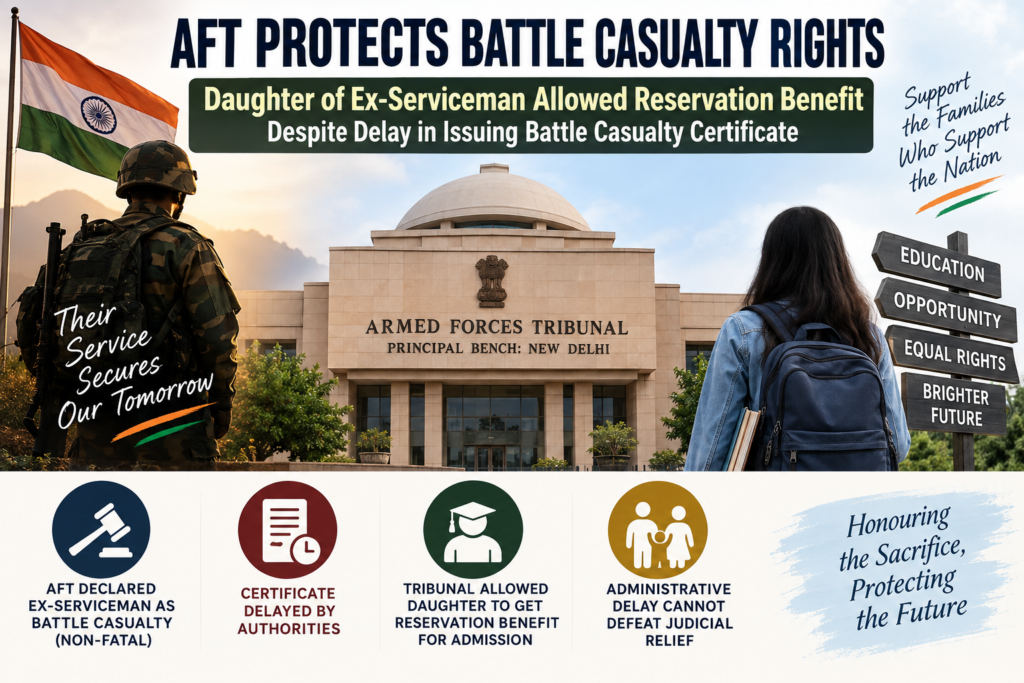
A recent order of the Armed Forces Tribunal (AFT), Principal Bench, New Delhi provides important relief to Armed Forces personnel and their families where benefits flowing from a judicial order are being delayed because the authorities have not issued the required certificate or implemented the order. The AFT directed that the daughter of an ex-serviceman who had already been declared a Battle Casualty (Non-Fatal) should be given the applicable reservation benefit for admission, even though the authorities had not yet issued the formal Battle Casualty Certificate.
The order is particularly significant because the Tribunal ensured that administrative delay did not defeat the substantive benefit already granted by a judicial order.
What was the case before the Armed Forces Tribunal?
The matter arose from MA No. 1165/2026 in OA No. 1203/2022 before the Principal Bench of the Armed Forces Tribunal at New Delhi. The application was filed for execution of the Tribunal’s earlier order dated 2 September 2025. According to the order dated 31 August 2026, the Tribunal had already directed that the applicant be treated as a Battle Casualty (Non-Fatal)and that all consequential pensionary and disability benefits be granted to him. However, the order had still not been implemented even though almost a year had passed. The Bench comprised Hon’ble Mr Justice Rajendra Menon, Chairperson, and Hon’ble Ms Rasika Chaube, Member (A).
Why did the matter become urgent?
The delay had consequences beyond the applicant’s pensionary benefits. The applicant’s daughter had appeared in the NEET examination and was seeking admission to an appropriate college. If the Battle Casualty Certificate was issued, she could claim the reservation benefit available as the ward of a Battle Casualty. The problem was simple but serious: the Tribunal had already declared the applicant a Battle Casualty, but the authorities had not issued the certificate. As a result, the daughter faced the possibility of losing her admission-related reservation benefit merely because of the delay on the part of the authorities.
AFT had already directed issuance of PPO and Battle Casualty Certificate
The order records that on 22 May 2026, the respondents had been directed to issue the PPO as well as the Battle Casualty Certificate. Yet, according to the Tribunal, even by 31 August 2026, nothing had been done. The OIC Legal Cell informed the Tribunal that issuance of the Battle Casualty Certificate would take at least another four weeks. The applicant’s counsel pointed out that waiting for the certificate could result in the applicant’s daughter losing the benefit of reservation and consequently her opportunity for admission.
This placed the Tribunal before an important practical question: Should a person lose a benefit already flowing from a judicial declaration simply because the Government has not completed the consequential paperwork? The AFT effectively answered this question in the negative.
AFT grants reservation benefit without waiting for formal certificate
The most important part of the order is paragraph 6. Taking note of the situation, the Tribunal directed that since the applicant had already been declared a Battle Casualty (Non-Fatal) by its earlier order, the authorities dealing with the daughter’s admission should give her the benefit of reservation in the Battle Casualty category.
The Tribunal further directed that, on production of its orders, the applicant’s daughter: “shall be treated as a ward belonging to a personnel who is declared as a Battle Casualty” and the applicable reservation benefit for admission should be extended to her. This was an important practical relief. Instead of requiring the daughter to wait until the administrative machinery formally issued the certificate, the Tribunal allowed its judicial order itself to operate for the purpose of admission.
Why is this AFT order important?
The significance of the order extends beyond the individual case. Government and military benefit cases often involve several stages. A serviceman may first have to establish his legal entitlement before the AFT. Even after succeeding, he may have to wait for issuance of a PPO, certificate, sanction letter or other consequential document. Such delays can sometimes make the original relief meaningless.
This case demonstrates an important approach: once the substantive status of an individual has already been judicially determined, administrative delay in issuing the consequential document should not ordinarily be allowed to destroy a time-sensitive benefit flowing from that status. In this case, the admission process could not simply wait indefinitely for departmental paperwork.
Important lesson for Armed Forces personnel and veterans
The order carries a useful lesson for serving personnel, veterans and their families. Where an AFT or court order has already recognised a status or entitlement, but the department is delaying its implementation, the affected person need not necessarily remain helpless until the administrative process is completed. Depending on the facts, an execution application or appropriate further application before the Tribunal may be considered to seek implementation or urgent consequential relief. This becomes particularly important where delay may result in an irreversible loss, such as:
- admission or educational reservation;
- pension and disability benefits;
- issuance of PPO;
- Battle Casualty benefits;
- employment or reservation benefits available to dependants;
- medical or welfare benefits; or
- any benefit having a fixed deadline.
The present order illustrates how execution proceedings can sometimes be used not merely to complain about non-compliance, but to seek effective relief so that the original judgment does not become meaningless through administrative delay.
Administrative delay should not defeat judicial relief
An important takeaway from the case is the distinction between recognition of a right and issuance of a document recording that right. Here, the applicant had already been declared a Battle Casualty (Non-Fatal) by the Tribunal. The Battle Casualty Certificate was consequential to that determination.
When delay in issuing the certificate threatened the daughter’s reservation benefit, the Tribunal stepped in and directed the admission authorities to act on the basis of its judicial orders. The order therefore has practical significance in cases where Government departments delay implementation of AFT or court directions. It reinforces a straightforward principle of effective justice: a successful litigant should not lose the practical benefit of a judicial order merely because the administration has failed to complete the consequential formalities in time.
What can veterans do when an AFT order is not implemented?
Every case depends upon its own facts and the wording of the original order. However, where an AFT judgment remains unimplemented, the affected person should carefully examine whether further proceedings for implementation or execution are appropriate.
The applicant should preserve the original AFT order, representations seeking implementation, communications with the authorities, proof of non-compliance and, importantly, evidence showing any urgent or irreversible prejudice caused by continued delay. The present case is a good example. The impending admission process gave the non-implementation an immediate consequence: the daughter could lose a reservation benefit even though her father’s Battle Casualty status had already been recognised.
Conclusion
The order in Ex Sub Gaikwad Sarjerao Namdeo v. Union of India & Others is a useful example of the Armed Forces Tribunal granting effective and practical relief against delay in implementation of its orders. The Tribunal did not allow the absence of a formally issued Battle Casualty Certificate to deprive the applicant’s daughter of the reservation benefit arising from her father’s already-recognised status.
For Armed Forces personnel, veterans and their dependants, the case sends an important message: winning a case is not necessarily the end of the legal process. Where an order is not implemented and delay threatens to defeat the benefit granted by the Tribunal, timely execution proceedings may become necessary.
About the Author
Ajit Kakkar & Associates, New Delhi, appears before the Supreme Court of India, Delhi High Court and other high courts, the Central Administrative Tribunal and Armed Forces Tribunal (Principal Bench) in matters related to Service law for Army, Navy, Air Force, BSF, CRPF, CISF, ITBP, Coast Guard, Assam Rifles, GREF, Delhi Police, Civilian Govt Employees and other Govt employees.
